
The Definitions of Psychological Injury
(Not Yet Commenced)
This article outlines the key definitions and shows which psychological injuries will be compensable.
Please note – Business NSW does not yet know whether these definitions will be adopted by the WHS laws or are only applicable for workers’ compensation purposes, but they may help you get a better idea of what you should be thinking about when managing your psychosocial risks.
The injury definitions
This figure illustrates the types of psychological injuries that will be compensable. The definitions of each are set out below.
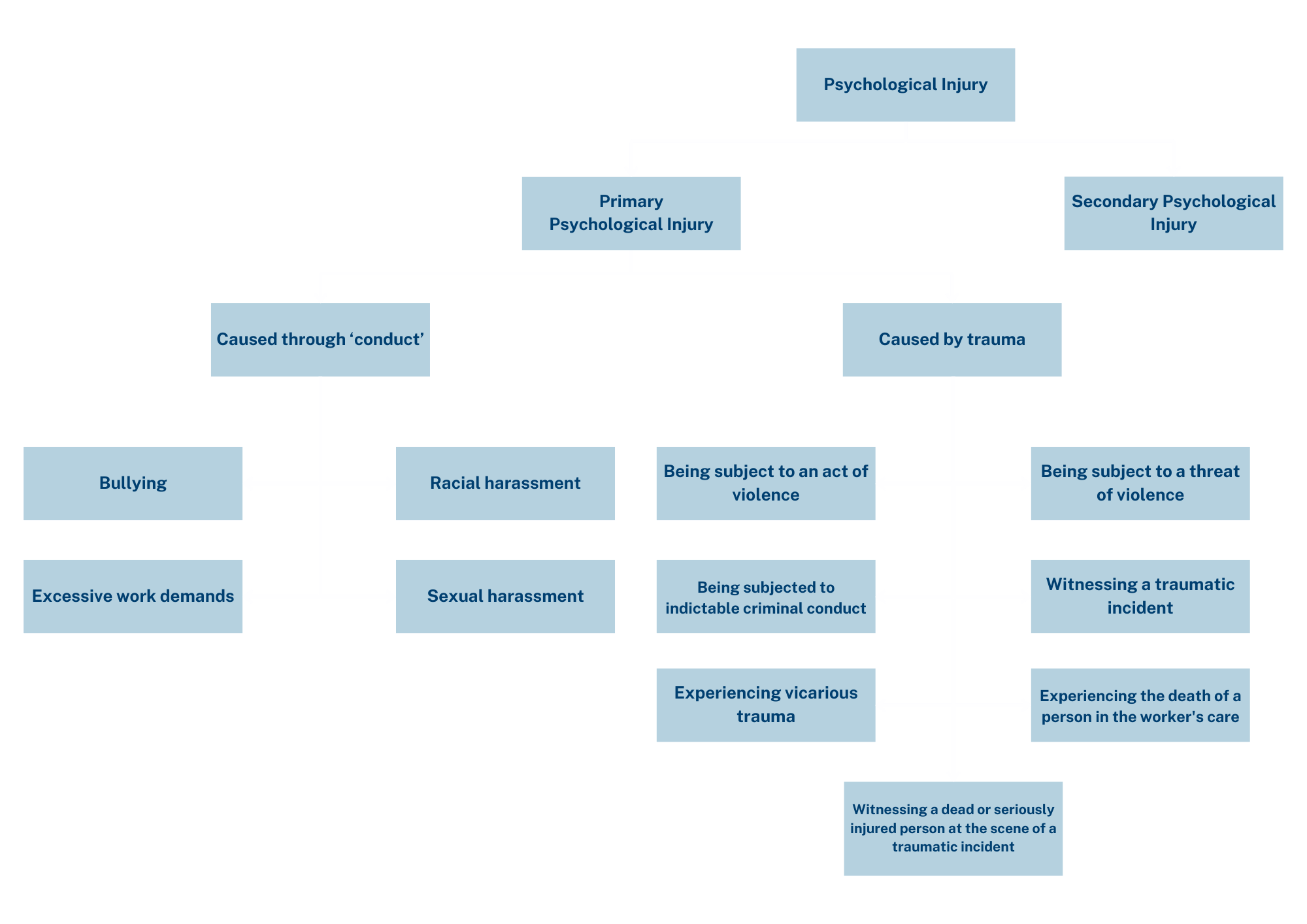
Psychological injury
In this Act, psychological injury means an injury that is a mental or psychiatric disorder that causes behavioural, cognitive or psychological dysfunction.
Primary psychological injury
In this Act, primary psychological injury means a psychological injury that is not a secondary psychological injury.
Secondary psychological injury
In this Act, secondary psychological injury means a psychological injury to the extent the psychological injury arises as a consequence of, or secondary to, a physical injury.
The ‘conduct’ definitions
Bullying
In this Act, bullying, in relation to a worker, means an individual or a group of individuals repeatedly behaving unreasonably towards the worker or a group of workers of which the worker is a member.
Excessive work demands
What they are
In this Act, excessive work demands, in relation to a worker, means work demands that are –
beyond the requirements expected of the worker’s role, and
repeated or persistent, and
not reasonable in all the circumstances.
Matters to take into consideration
In determining whether work demands made of a worker are excessive work demands, the following matters must be considered –
the usual patterns of work in the industry, or part of the industry, in which the worker is employed,
supervision of the worker, including –
level of control over the worker’s tasks, and
whether there is unreasonable surveillance of the worker,
the nature of the worker’s role, the worker’s level of responsibility and the nature of the worker’s employment arrangement,
whether the worker is entitled to receive –
overtime payments, penalty rates, an on-call allowance or other compensation for working additional hours, or
a level of remuneration that reflects an expectation of working additional hours,
the needs of the workplace in which the worker is employed,
staffing levels in the workplace, including the mix of qualifications and skills of employees, as the levels and mix relate to the worker’s workload,
industrial agreements and arrangements relevant to the worker,
repeated and serious contraventions of the Work Health and Safety Act 2011 and the regulations made under that Act and any other relevant work health and safety requirements,
another relevant matter.
Racial harassment
In this Act, racial harassment, in relation to a worker, means an act that is –
reasonably likely in all the circumstances to offend, insult, humiliate or intimidate the worker, and
done because of the race, colour or national or ethnic origin of the worker.
Sexual harassment
In this Act, sexual harassment, in relation to a worker, means a person who:
makes:
an unwelcome sexual advance, or
an unwelcome request for sexual favours,
to the worker, or
engages in other unwelcome conduct of a sexual nature in relation to the worker.
The ‘trauma’ definitions
Act of violence
Act of violence has the same meaning as in the Victims Rights and Support Act 2013.
Note – that Act contains very long definitions relating to an act of violence. A separate downloadable fact sheet will be developed and uploaded to this website as soon as its ready.
Traumatic incident
In this Act, a traumatic incident means –
any of the following incidents if the incident results in, or is likely to result in, the death of, or serious injury to, a person –
an act of violence,
indictable criminal conduct,
a natural disaster, fire or explosion,
a motor accident or other accident, or
a suicide or attempted suicide, or
an incident prescribed by the regulations.
Note – no regulations have yet been created for these new laws.
Indictable criminal conduct
Indictable criminal conduct –
means the commission of an indictable offence, and
includes conduct of a person that would constitute an indictable offence were it not for the fact the person must not, or may not, be held criminally responsible for the conduct because of the person’s age or mental illness or impairment.
Vicarious trauma
In this Act, vicarious trauma means the psychological impact of repeated exposure, in the course of a worker’s duties, to the traumatic experiences of others that result from traumatic incidents.

The new laws will require a much stronger connection with the workplace.
Learn more in our next article.