
What Is ‘Discrimination’ When It Relates to Disability³?
There are two aspects to whether unlawful discrimination has taken place.
They relate to:
The types of behaviours engaged in, and
The circumstances in relation to those behaviours.
The Behaviours
Person A will discriminate against Person B if, on the ground that Person B (or as associate or relative of Person B) has a ‘disability’ (as defined by the Act), Person A behaves in one of two ways.
Situation #1
Where Person A treats (or would treat) Person B less favourably:
than someone:
who doesn’t have that disability, or
whose relative or associate doesn’t have that disability),
in:
the same circumstances, or
circumstances which are not materially different.
It’s important to note that ‘discriminating on the ground of disability’ includes situations where it involves discriminating on the basis of a characteristic that either:
appertains generally to persons, or
is generally imputed to persons,
who:
have the type of disability that Person B has, or
has a disability substantially the same as Person B’s disability.
Examples of a characteristic that ‘appertains generally’ include the fact that a person who has a disability:
relating to vision, hearing or mobility has, or may be accompanied by, a dog which assists the person in respect of that disability,
is accompanied by, or possesses, a palliative or therapeutic device, or other mechanical equipment, that provides assistance to the person to alleviate the effect of the disability, or
is accompanied by an interpreter, a reader, an assistant, or a carer, who provides interpretive, reading or other services to the person because of the disability, or because of any matter related to that fact.
Situation #2
Where Person A requires Person B to comply with a requirement or condition:
with which a substantially higher proportion of persons who do not have that disability (or who do not have a relative or associate who has that disability):
comply or
are able to comply, and
being a requirement:
which is not reasonable having regard to the circumstances of the case, and
with which Person B does not or cannot comply with.
Exceptions to these rules include situations:
where a person:
has an infectious disease and the discrimination is reasonably necessary to protect public health, or
is addicted to prohibited drugs,
in relation to:
terms and conditions relating to superannuation or insurance, or
sporting activities.
The Circumstances
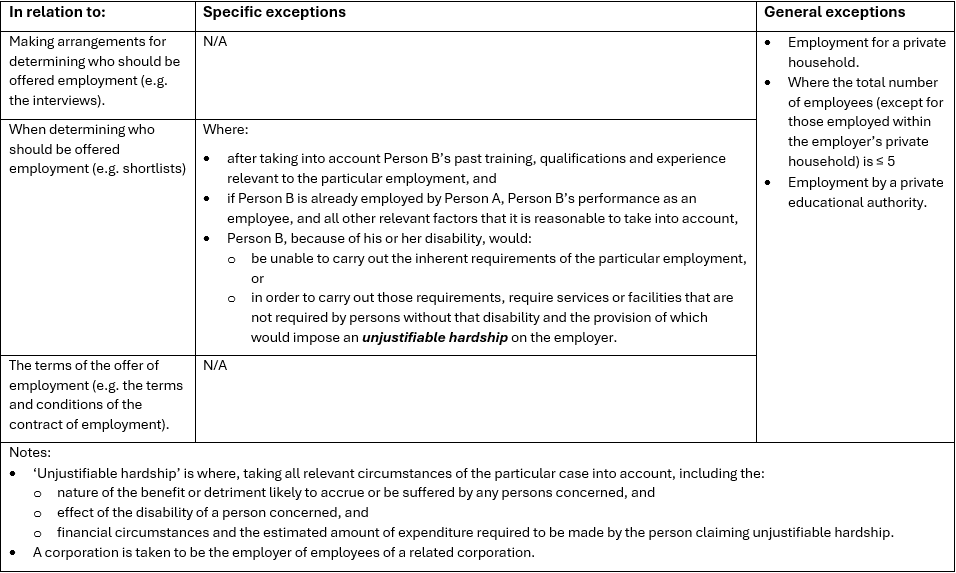
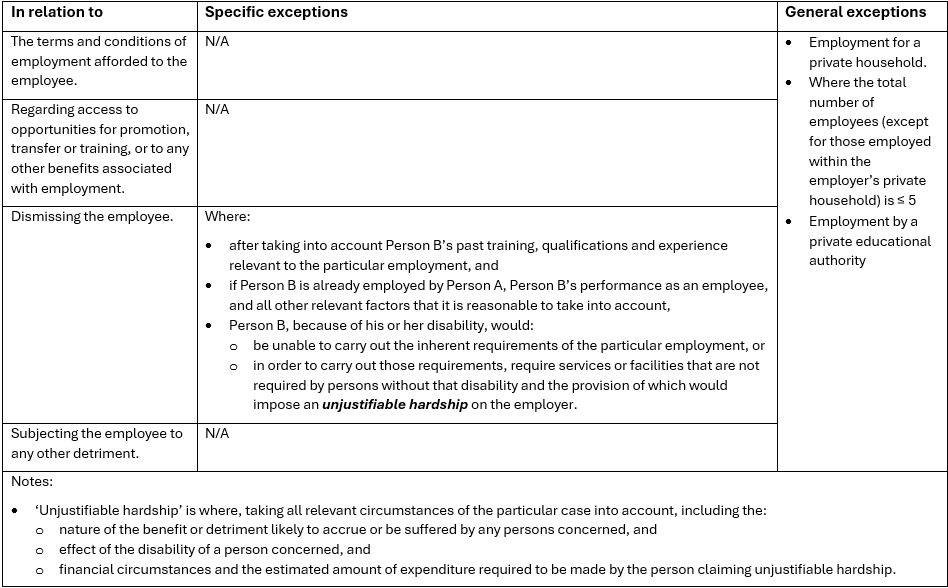
The Act provides specific examples of discrimination based on the grounds of disability. Some examples are contained in the tables below.
Employer (Person A) v Job Applicant (Person B)
Employer (Person A) v Employee (Person B)
³Section 49B What constitutes discrimination on the ground of disability