
What are business systems and why are they important?
A PCBU’s primary duty of care under WHS laws includes a duty to provide and maintain ‘safe systems of work’[1].
However, those laws do not define what ‘safe systems of work’ are, so we need to look elsewhere to gain a better understanding of what the phrase ‘safe systems of work’ actually means.
Systems of Work
A good starting point is with the phrase ‘systems of work’.
Basically, it is a catch-all phrase to describe all the activities that are undertaken by a business entity in order to create its product (whether it’s a good or a service). As this includes the way a business conducts its business relationships with suppliers and customers, they need to be taken into account as well.
A handy way to think about this concept is through the various spheres of influence (as shown by the blue shading) which a business owner operator has in relation to its own activities as well as to the activities of its suppliers and customers (see Figure 1, below).
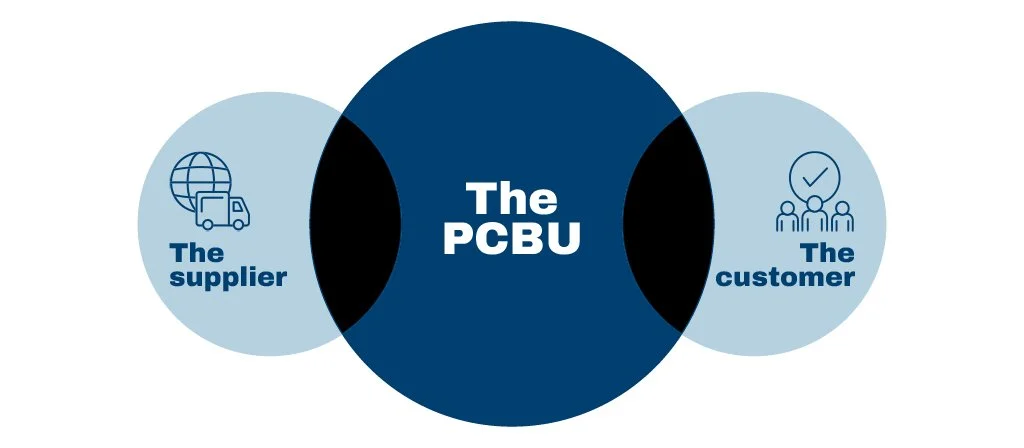
As you can see, this ties neatly into a PCBU’s obligations under WHS laws.
A safe system of work
Although the WHS laws don’t define what a ‘safe system of work’ is, the concept was explained by the High Court in 1986[1] in relation to whether a tree-felling business was negligent for not providing a safe system of work.
That case is relevant from a WHS perspective, because WHS laws are based on the common law concepts of negligence.
In that case, the business owner had an exclusive licence to cut and take away logs from particular logging areas.
To do this, the business:
allocated ‘fellers’ (who cut the trees), ‘sniggers’ (who moved the cut logs away from where they fell to a ramp so they could be loaded onto the back of trucks) and truck drivers (who drove their loads to a timber mill) to specified parts in those logging areas,
required them to work together in teams (who were required to follow a process of extracting timber from the forest and delivering it to the sawmill, and
monitored and co-ordinated the operations through its employee (known as the ‘bush boss’).
The Court recognised that some of the workers were independent contractors, but that the “interdependence of the activities carried out in the forest, the need for co-ordination by Brodribb of those activities and the distinct risk of personal injury to those engaged in the operations, called for the prescription and provision of a safe system by Brodribb. Omission to prescribe and provide such a system would expose the workers to an obvious risk of injury . . . The fact that they are not employees, or that he does not retain a right to control them in the manner in which they carry out their work, should not affect the existence of an obligation to prescribe a safe system. Brodribb's ability to prescribe such a system was not affected by its inability to direct the contractors as to how they should operate their machines.”
In that case, the Court held that the tree-felling business did prescribe and provide a safe system of work.
Remember, the obligation to provide a safe system of work is already required under WHS law. It is a key component of a PCBU’s Primary Health & Safety Duty. The purpose for this blog post is to explain what is meant by the phrase ‘a safe system of work’, given that it hasn’t been defined by the WHS laws.